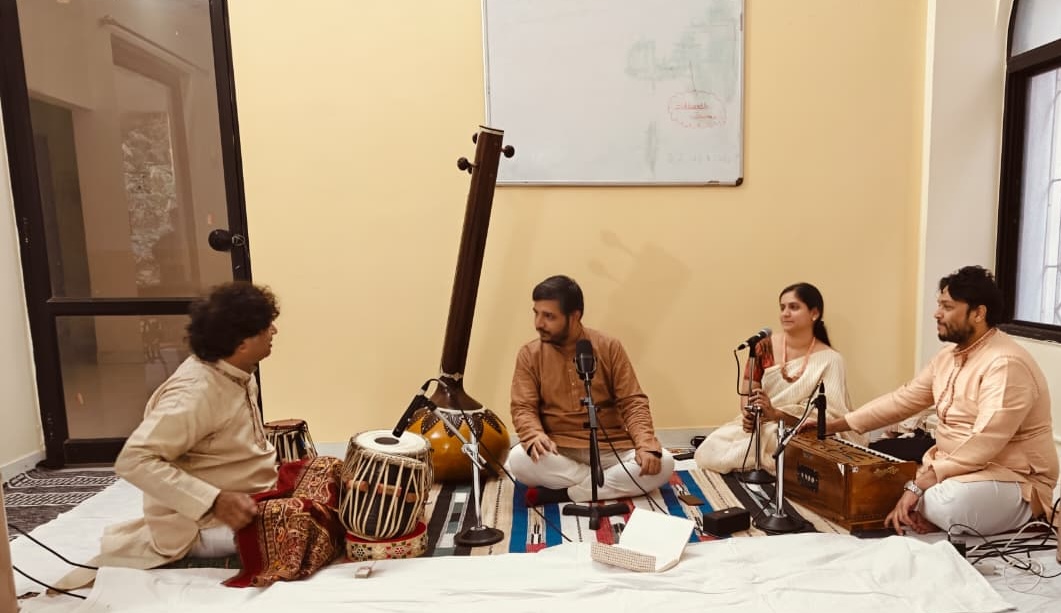
Every phrase I sing is like a brick. With every breath I take, I sing a phrase, and I lay a brick. But unlike the normal brick, which stays eternally where it is kept, my brick – the musical expression, disappears in space and time. But I keep laying them out. At the end, what remains is pure silence and void and yet, a structure gets built. I feel it; my audience feels it. They carry this structure built with breath and voice with them and cherish it for days and years to come….
These are the words of Pt. Kumar Gandharva – an exceptionally talented musician who never entered a school! When Kumar Gandharva sang or spoke, prominent poets, philosophers, artists, architects, scientists and even mathematicians listened. Why would a bunch of scholars and intellectuals pay so much attention to the words of an illiterate singer? The most probable answer is that he discovered something through his music practice, which a scientist aspires to discover through his science or a mathematician through complex regressions or an architect after messing up a hundred structures.
But the example of Kumar Gandharva is not an isolated one. Till the early half of the twentieth century, most of the musicians were either illiterate or moderately learned. Very few were privy to higher education. And yet, their expressions carry the depth that is rare even for highly learned individuals. Sustaining oneself as a full-time musician is not easy. In the old days, when art managers were nonexistent, artists did everything by themselves – from writing letters and arranging tours to fixing royalties and finding out if they were being cheated by a festival organiser.
Above all, they flourished in the highly insecure and political space of the performing arts.
Where did they receive this training? Who imparted these skills to them?
I think just like a child going to school is likely to learn how to deal with bullies in the school without any tutoring for it, music practice provides opportunities to gather wisdom, skills and values which going through a formal schooling system cannot guarantee.
I vividly remember an example. Some time back, we hired a young, talented Tabla player as a project coordinator in Baithak. He was in need of a stable income and hence applied for a full-time job. He was hired and was performing satisfactorily, except for a few blunders here and there. After eight months, he told us that he wanted to quit.
I told him that we were satisfied with his performance and that with the passing of time, he would be much better. The answer that he gave was an eye-opener.
“Yes, I know I can do it, but you know, I always have the thought lurking in my mind – what if I missed something? What if I make a mistake? These thoughts do not allow me to focus on my practice, and that is getting reflected in my playing. Instead, I want to focus on developing myself as a solo Tabla artist. As for earning my bread, I am slowly building my own classes and will try my best to grow them and earn from them.”
I have seen my friends in IIMs getting insecure and accepting the first job offer they get out of that insecurity, and getting stuck into doing the work they hate to do or starting their career in a line which they were not at all passionate about.
I admire the clarity this Tabla player had – that too without going to a fancy B-school. Ten months after that conversation, he is on track – he is emerging as a promising Tabla soloist and his classes are growing steadily. This kind of clarity rarely comes from formal education. It comes from finding out what you really like to do and then sticking to it no matter what!
When I look at my own journey, my education in school gave me knowledge about a particular subject, but it did not help me know myself better. How I solved a maths problem or how I wrote my geography paper does not tell me much about myself, but how I approach and elaborate a Raag tells me a lot bout my breath, my temperament and my maturity. As a result, when you learn an art form, let’s say music, from an experienced Guru and practice under their guidance, sooner or later, the conversation comes to you – who you are in that moment.
My work with schools takes me to many schools, organisations, retreats and gatherings about education in general. One thing that I increasingly observe is the lack of availability of time that parents and teachers have. When it comes to love, care and attention, I feel almost every child is underprivileged. Fortunately, in my case, my mother quit her job after my elder brother was born and remained a housewife thereafter. Despite her being totally available, I would spend a significant amount of time with my Gurus. Under the ideal situation, the whole practice of music is such that the Guru and the Shishya have to spend a lot of time together. I was fortunate that all my Gurus were very caring. It created one more focal point of love and care in my life, and I am sure any student of music will be able to relate to this. Many of them will comfortably share things with their Gurus that they cannot share with their parents. Learning under a caring Guru can provide an additional source of love that can completely change one’s trajectory in life.
This brings me to my next point. What about the time that we spend with ourselves?
With the rise of handheld devices and Apps, teachers in the remotest of schools complain of screen addiction among pupils. Sadly, children are spending less and lesser amount of time with themselves. As I remember, through grades fourth to ninth, I would spend a minimum of three hours every day with myself – during my daily practice. These three hours excluded the time I spent at my Guru’s place. Back at home, whenever I did my homework, I wanted to get it over with as soon as possible. I always felt my singing practice should go on for hours!
It is difficult to put a finger on it, but I can certainly say that those hours that I spent with myself have shaped my life in some way or the other. It is probably during these hours that I got clarity of what I really wanted to do with my life. Even today, I practice as much as I can – even if I have driven for 500 kms to get back home, I will turn the Tanpura on and sing for fifteen to twenty minutes. The outcome is not polished musical expression but re-establishing that connection with myself.
Whether we agree or not, life has become like a machine that extracts the juice out of every human being. Every child who is in school today will aspire to get a job that will pay the bills. Most of the time, the job will enrich the child very little beyond the money it offers. What can be the source of our personal enrichment and rejuvenation? I feel music practice beautifully fills this void.
About the Author
Mandar Karanjkar is a student of life and music. He is a disciple of late Pt. Vijay Sardeshmukh and is currently learning from Pt. Vivek Joshi. Mandar is a co-founder of Baithak Foundation – www.baithak.org a not for profit taking traditional Indian music and dance to 8000+ children in government schools. Mandar is also a speaker, an author and a communications consultant.
Leave a Reply